


Understanding the human body is fascinating, from its smallest parts of the body to complex human body systems. Every human anatomy organ plays a role in keeping the body systems and their functions working smoothly. Learning the scientific names of human body parts helps you identify human body parts, explore the anatomy of the body, and understand human body structure clearly. Whether you want to know about all body systems, 12 body systems and functions, or the connections between body parts, this guide makes human anatomy easy to grasp for students, educators, and anyone curious about their body systems.
Names with meanings
- Corpus – body
- Caput – head
- Cervix – neck
- Truncus – torso
- Dorsum – back
- Pectus – chest
- Abdomen – belly
- Pelvis – hip region
- Femur – thigh bone
- Cranium – skull
- Facies – face
- Manus – hand
- Pes – foot
- Digitus – finger or toe
- Oculus – eye
- Auris – ear
- Nasus – nose
- Oris – mouth
- Mentum – chin
- Gula – throat
Chemical Composition of the Human Body
The human body is made of chemical elements and compounds that support structure and function. Water is the most abundant component, followed by proteins, lipids, carbohydrates, and minerals. These substances allow cells to grow, repair damage, and communicate with one another. Chemical balance is essential for energy production, immunity, and organ performance. Learning how chemistry shapes anatomy becomes easier when paired with the scientific names of human body parts, which provide universal terminology across science and medicine.
Names with meanings
- Cellula – small cell
- Cytosol – cell fluid
- Membrana – thin covering
- Nucleus – control center
- Mitochondrion – energy producer
- Ribosoma – protein builder
- Enzyma – catalyst protein
- Plasma – liquid portion
- Hemoglobin – oxygen carrier
- Calcium – bone mineral
- Phosphorus – energy element
- Sodium – fluid regulator
- Potassium – nerve signal ion
- Chloride – balance ion
- Lipidum – fat molecule
- Proteinum – structural compound
- Carbohydratum – energy source
- Oxygenium – breathing gas
- Nitrogenium – protein base
- Carbonium – life framework
Levels of Organization in the Human Body
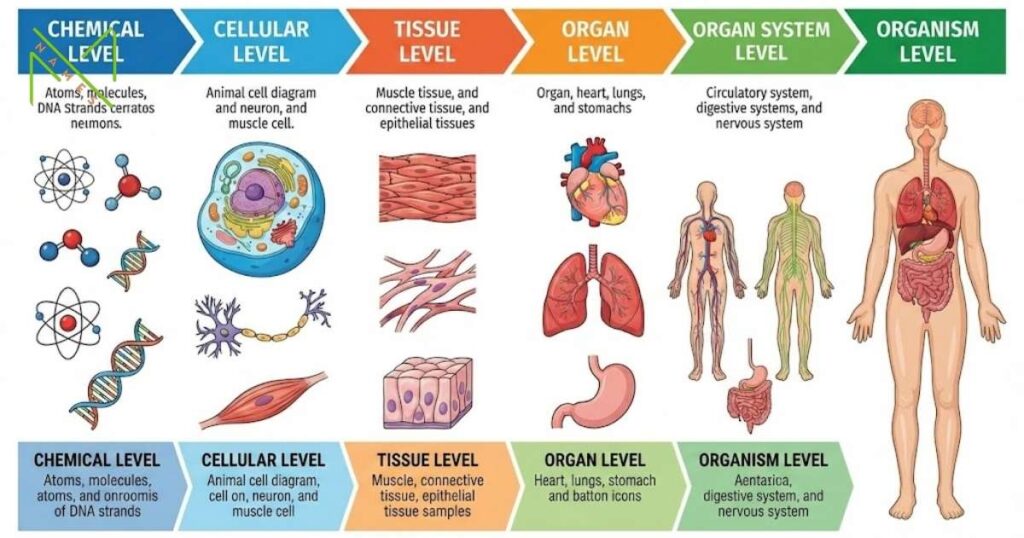
The human body is structured in levels that range from microscopic to fully formed systems. Cells combine to form tissues, tissues build organs, and organs work together in systems. This organization allows specialization and efficiency, ensuring that each level supports the next. Understanding these layers helps explain how damage at one level can affect the entire body. Using the scientific names of human body parts helps standardize how these levels are described in education and research.
Names with meanings
- Textus – tissue
- Organum – working unit
- Systema – organized group
- Epithelium – covering tissue
- Connectivum – binding tissue
- Muscularis – movement tissue
- Nervosum – signaling tissue
- Cellula stemma – stem cell
- Fibra – threadlike structure
- Matrix – support framework
- Lumen – inner space
- Cortex – outer layer
- Medulla – inner core
- Parenchyma – functional tissue
- Stroma – supporting tissue
- Sinus – cavity
- Lamina – thin layer
- Node – junction point
- Segmentum – divided part
- Unitus – combined structure
Major Organ Systems and Their Functions
Organ systems are groups of organs that perform shared functions to keep the body alive. Each system has a specific role, such as movement, digestion, or communication, yet all systems depend on one another. When systems work in harmony, the body maintains stability and health. Learning the scientific names of human body parts allows for clear discussion of how systems interact in both normal and clinical settings.
Names with meanings
- Systema osseum – bone system
- Systema musculare – muscle system
- Systema nervosum – nerve system
- Systema digestorium – digestion system
- Systema respiratorium – breathing system
- Systema cardiovasculare – blood transport system
- Systema endocrinum – hormone system
- Systema lymphaticum – immune fluid system
- Systema urinarium – waste removal system
- Systema reproductivum – reproduction system
- Systema integumentarium – skin system
- Hepar – liver
- Cor – heart
- Pulmo – lung
- Ren – kidney
- Cerebrum – brain
- Ventriculus – stomach
- Intestinum – intestine
- Pancreas – enzyme organ
- Splen – spleen
The Skeletal and Muscular Systems
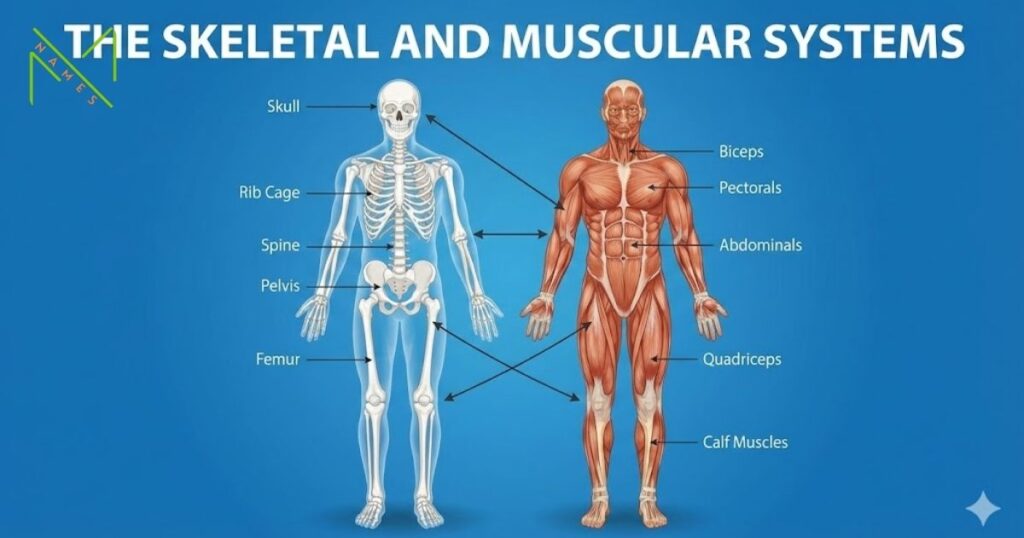
The skeletal and muscular systems work together to support the body and allow movement. Bones provide structure and protection, while muscles generate force and motion. Joints connect bones and enable flexibility, making daily activities possible. Damage to either system can limit mobility and balance. Understanding anatomy through the scientific names of human body parts improves clarity when studying movement and physical health.
Names with meanings
- Os – bone
- Skeleton – bone framework
- Cartilago – cartilage
- Articulatio – joint
- Ligamentum – bone connector
- Tendon – muscle connector
- Musculus – muscle
- Biceps – two headed muscle
- Triceps – three headed muscle
- Femur – thigh bone
- Tibia – shin bone
- Fibula – calf bone
- Humerus – upper arm bone
- Radius – forearm bone
- Ulna – inner forearm bone
- Patella – kneecap
- Scapula – shoulder blade
- Vertebra – spine bone
- Sternum – breastbone
- Cranium – skull
Control, Transport, and Regulation Systems
The body relies on control and transport systems to send signals, move substances, and maintain balance. The nervous and endocrine systems regulate actions and responses, while the cardiovascular and lymphatic systems transport blood, nutrients, and immune cells. These systems respond quickly to changes and protect the body from harm. Using the scientific names of human body parts ensures precise understanding of how regulation and transport keep the body stable.
Names with meanings
- Neuron – nerve cell
- Cerebellum – balance center
- Hypothalamus – control regulator
- Pituitary – master gland
- Arteria – blood vessel
- Vena – returning vessel
- Capillaris – tiny vessel
- Lympha – immune fluid
- Nodulus – lymph node
- Aorta – main artery
- Ventriculus cordis – heart chamber
- Atrium – heart entry
- Synapsis – nerve junction
- Hormona – chemical messenger
- Ganglion – nerve cluster
- Spinalis – spinal cord
- Plasma – blood liquid
- Platelet – clot cell
- Erythrocyte – red blood cell
- Leukocyte – white blood cell
Systems Involved in Exchange, Nutrition, and Waste Removal
The body must exchange gases, absorb nutrients, and remove waste to survive. The respiratory system brings in oxygen, the digestive system processes food, and the urinary system removes excess substances. These systems work continuously to maintain internal balance and energy levels. Understanding these processes becomes clearer when learning the scientific names of human body parts used in biology and medicine.
Names with meanings
- Pulmo – lung
- Bronchus – airway tube
- Alveolus – air sac
- Diaphragma – breathing muscle
- Oesophagus – food tube
- Ventriculus – stomach
- Duodenum – first intestine
- Jejunum – middle intestine
- Ileum – lower intestine
- Colon – large intestine
- Hepar – liver
- Vesica fellea – gallbladder
- Ren – kidney
- Ureter – urine tube
- Vesica urinaria – bladder
- Urethra – exit channel
- Saliva – digestive fluid
- Enzyme – breakdown protein
- Oxygen – life gas
- Carbon dioxide – waste gas
Growth, Development, Aging, and Adaptation
Human growth and development begin before birth and continue through adulthood, followed by gradual aging. Cells divide, tissues mature, and systems adapt to environmental and lifestyle changes. Aging affects structure and function, but healthy habits can support long term balance. Learning the scientific names of human body parts helps explain how development and aging impact different regions of the body over time.
Names with meanings
- Embryo – early development stage
- Fetus – later development stage
- Infans – newborn
- Pubertas – maturity phase
- Adultus – fully grown
- Senectus – aging stage
- Telomere – chromosome end
- Osteoporosis – bone thinning
- Sarcopenia – muscle loss
- Neuroplasticity – brain adaptation
- Regeneratio – tissue repair
- Mutation – genetic change
- Adaptatio – adjustment process
- Homeostasis – internal balance
- Immunitas – defense strength
- Metabolismus – energy process
- Hormonal shift – chemical change
- Degeneratio – functional decline
- Longevitas – lifespan
- Vitalitas – life energy
Conclusion
Exploring the scientific names of human body parts reveals how intricate and organized the human body really is. From individual body parts to entire human body systems, understanding human anatomy organs and body systems and their functions gives insight into human body structure and the anatomy of the body. Knowing about all body systems, 12 body systems and functions, and how human body parts work together strengthens your knowledge of human anatomy and keeps you curious about your body systems. This knowledge connects everyday life to the amazing science of human body systems.
